Showing posts with label Googletrends. Show all posts

Friday, September 14, 2012

Update Google Chrome

To make sure that you're protected by the latest security updates, Google Chrome automatically updates whenever it detects that a new version of the browser is available. The update process happens in the background and doesn't require any action on your part.

Check for updates

Updates are available if the wrench icon on the browser toolbar shows a little arrow  update notification. To apply the update, just follow the steps below.
  1. Click the wrench icon on the browser toolbar.
  2. Select Update Google Chrome.
  3. In the confirmation dialog that appears, click Restart. The browser saves your opened tabs and windows and reopens them automatically when it restarts. If you'd prefer not to restart right away, click Not now. The next time you restart your browser, the update will automatically be applied.
More information for Mac and Linux users

Check your browser version

Click the wrench icon on the browser toolbar and select About Google Chrome. The version number is the series of number beneath the "Google Chrome" heading.

More information

  • Having problems updating? See troubleshooting information
  • Learn about the features and fixes included in each update at the Google Chrome Releases blog.
  • Google Chrome uses a process called Google Update to periodically check for updates. This process sends information, such as version number, language, operating system, and other installation or update-related details, back to Google servers. This information is not associated with you or your Google Account. Learn more about how Google Update works.

Tuesday, September 4, 2012

Google+ Starts Rolling Out Custom URLs

There's annihilation like a amusing networking URL involving added than 20 numbers to accomplish a user ache for article easier to remember, and on Monday Google appear that it's amorphous to bear aloof that.Specifically, companies and individuals application Google+ will anon be able to affirmation a custom URL for use instead of the long, klunky ones they've had so far.

“Today we’re introducing custom URLs to accomplish it alike easier for bodies to acquisition your contour on Google+,” wrote Google artefact administrator Saurabh Sharma in a column on the company's amusing arrangement on Monday.

Short and Sweet

Currently, Google+ contour URLs are ungainly at best. Mine, for example, is the actual addictive “https://plus.google.com/105492284418862345045/.”

With a custom URL, however, users of the accepted amusing arrangement will be able to use a short, easy-to-remember Web abode instead that will articulation anon to their contour or folio on Google+.

“For instance, +TOYOTA can now use google.com/+toyota to bare their latest models, +Britney Spears can allotment her accessible appearances at google.com/+britneyspears, +Ubisoft can allotment bold trailers and videos at google.com/+assassinscreed, and +Delta can advice travelers acquisition abundant deals at google.com/+delta,” Sharma explained.

Starting Small

The new account will be accessible to accumulated and alone users about the globe, but it's not accessible to anybody aloof yet.

To begin, Google is rolling out custom URLs alone to a bound set of absolute profiles and pages on Google+, the aggregation explained on its own profile, which can now be begin at google.com/+googleplus. “While we're not absolutely accessible for anybody to alpha claiming their own custom URLs, we plan to aggrandize the availability over time,” it added.

There's no agnosticism ardent alone Google+ users will account from easier-to-share contour addresses, but brands will absolutely acknowledge the new account alike more. If your aggregation is on Google+, this will be an accomplishment to watch carefully so you can snag the URL you want.

Cloud Company Ending 'Lifetime' Hosting Promise

Cloud accretion aggregation Joyent abreast barter this anniversary that a "lifetime" Web hosting action that it promised added than six years ago would be advancing to the end of its activity this fall.

In 2005 a aggregation called TextDrive -- which had affiliations with Joyent at the time -- offered alpha barter lifetime admission to Web hosting casework for an antecedent advance of $499. TextDrive eventually bankrupt into Joynet and bygone Joyent abreast baddest users that the lifetime Web hosting action would be advancing to an end.


"For abounding business reasons, including basement performance, account affection and manageability, these aboriginal articles are advancing their End of Life. We plan to dusk these casework on October 31, 2012," Joyent admiral abreast baddest customers, according to an email user Ken McKinney acquaint on his Google+ profile. Similar belletrist were acquaint by added Joyent customers, all acquainted that users accepting the email were "one of the few chump still on our aboriginal product."

As consolation, Joyent is alms barter the chargeless use of one of the company's SmartMachines for one year. That wasn't abundant for user Nick Carroll, who acquaint on his blog that "Joyent bamboozled me with a lifetime hosting deal." "Lifetime agency a lifetime," said affiliate odinsdream.
  • IN THE MONEY: It pays to be CIO: Corporate jets, clandestine security, car allowances and more
  • MORE CLOUD: Gartner's best over-hyped billow accretion terms
  • PLANES, TRAINS AND AUTOMOBILES OF TOMORROW: 12 air-conditioned approaching busline concepts
Many afflicted users assume decidedly agitated because they beheld their antecedent advance in the Web hosting casework as a array of crowd-sourced adventure advance to advice get TextDrive off the ground. In acknowledgment for demography a adventitious on the aggregation and advance in it, they were promised the lifetime of services.

Image from Joyent website.According to this annal acquaint on the association forum, the antecedent action amount $499 and included 15 top-level domains, 20GB of bandwidth per ages and 2GB of accumulator amplitude from TextDrive, forth with a "complete hosted appliance suite" from Joyent for up to bristles users that is acceptable for "as continued as we exist."

In anecdotic the end-of-life advertisement on the Joyent association forum, Joyent CTO Jason Hoffman apologized, adage that the company's business has afflicted and the accouterments to abutment the Web hosting was "too old," is not account replacing and is costing the blow of the business money. "I'm apologetic that I've absent that assurance and I've agitated you. You accept a appropriate to be upset. This was a boxy accommodation with some dash to it and none of this is absent on me," Hoffman wrote. He adds, "it's acrid that our better advocates are the ones best afflicted by this," but overall, he says, "I can't accomplish the altercation as to why it can continue."

Joyent offers a alternation of high-performance billow computing, analytics, accumulator and networking appearance and is one of a crop of infrastructure-as-a-service (IaaS) companies attractive to accretion bazaar allotment in the industry. Earlier this year, Joyent appear a new annular of $85 actor in adventure basic funding.

Google+ Sucks Up to More Big Shots With Vanity URLs

Google+ Sucks Up to Added Big Shots With Vanity URLs

Google this anniversary abundantly broadcast availability of custom URLs for users of its Google+ amusing networking site, a move advised to accomplish it easier for bodies and companies to advance their presence. Google+ users alignment from a disc golf accouterments to Google advisers to Dell CEO and Google Hangouts fan Michael Dell are amid aboriginal vanity URL recipients. Google CEO Larry Page, an exceptional Google+ poster, had not been adapted to a custom URL as of mid-afternoon Thursday.

Google said in June that it hosts 250 million-plus Google+ accounts, with 150 actor account alive users, a far cry from Facebook's added than 900 actor alive account users.Currently, best Google+ URLs are accidental cardinal strings that are adamantine to look for and remember. Google+ users whose absolute accounts accept been called for the appropriate URLs are actuality notified via their contour pages and email.
  • One bolt to the chump URLs, however, according to website Mashable, is that Google says in the accomplished book that it ability alpha charging for them some day.
  • Another bolt is that Google will acquaint you what your custom URL is, admitting you'll accept the befalling to abuse it through an appeals process.
  • Google's Saurabh Sharma -- who has a custom URL himself now -- wrote on Google+ today that "we'll be alms custom URLs to abounding added profiles and pages in the future."
#Vanityurl has been trending aerial on Google+ all day, alongside #tigerwoods and #rogerfederer, with users of the amusing arrangement armpit adulatory and affliction their status, as the case may be.

Some Google+ users were additionally advertisement that their absolute Google Contour custom URLs are still working, so are apprehensive what ability appear to them as the Google+ chump URLs cycle out.

Friday, August 17, 2012

Video Chat Service

Google Launches Free Video Chat Service

Google is accepting into the video babble bold with a new affection accessible as of Tuesday. Gmail Video and Voice offers Webcam-based video conferencing to all Gmail users. The account is accessible chargeless of charge.

How It Works

Gmail Video and Voice requires a browser constituent and either a microphone (for beeline audio chatting) or a Webcam (for video and audio chatting) to function. The constituent -- a proprietary, non-Flash-based arrangement -- runs about 2MB and supports Chrome, Firefox 2.0+, Internet Explorer 7.0, and Safari 3.0. As of now, the video babble account will not be fabricated accessible aural the standalone Google Talk application.

Once the constituent is installed, all you do is bang on a acquaintance aural your Gmail Babble list. If they additionally accept the appropriate software, a camera figure will pop up abutting to their name and let you admit a two-way multimedia session. If they don't accept the hardware, you can still alpha a one-way affair in which they'll be able to see and apprehend you, alike if you can't see and apprehend them. The account is accepted to be absolutely formed out to all Gmail users by the end of Tuesday.

The technology, by the way, comes from Google's accretion of video conferencing software by Marratech aftermost year. Google assassin the engineers complex in the software, at the time crumbling to acknowledge its ultimate plans.

See For Yourself

A Gmail architect demonstrates the action in the afterward video:


Ups and Downs

Gmail Video and Voice is a basal arrangement and seems added geared against accidental use than all-embracing accumulated use at this point. Unlike casework such as Skype Premium, the arrangement doesn't let you affix to approved buzz numbers -- alone to added Gmail Babble users. It additionally doesn't action a recording advantage and doesn't admittance conferences with added than two people.

With that actuality said, it's accession cleft in Gmail's ever-expanding belt of chip casework and could prove to be a accessible accession for users already logged into the system. Aural the ambit of Web-based e-mail, Gmail Video and Voice ends up actuality accession blare that'll added set Gmail afar from its aggressive platforms.

Tuesday, April 17, 2012

Confessions of a Google junkie

Confessions of a Google aficionado (or, Privacy? What privacy?)

There are actual few aspects of my activity that don’t somehow absorb Google. My buzz runs on Android, my admired book aloof got an OTA amend to Ice Cream Sandwich (!!!), I use Chrome beyond all of my computers, I advance AdWords campaigns, I use Analytics to advance metrics for the day job and dive into SEO, I handle abounding of the CBS Interactive Google webcasts, I use Google Docs about alone for productivity, and my wife doesn’t apperceive area I am bisected the time until she checks my Google Calendar (which, in fact, accumulated two added Google Calendars).

I’m added axis to Google+ as my antecedent of accordant advice and opinions, a action ahead aloof for Twitter, and I’ve alike dispensed with bookmarks, instead application Google Sites to adapt important pages and resources.

I live, eat, breathe, work, and comedy Google and there aren’t abounding bodies added acquainted of Google’s business archetypal and the bulk of abstracts it collects than I. So is it aloof arduous applesauce and naiveté that has me absolutely all-embracing the Google ecosystem and almost aloof about anew appear aloofness behavior that accept acquired so abundant alarm this week? Before you jump bottomward to the talkbacks to acquaint me how brainless I absolutely am, apprehend on for addition brace paragraphs.

As Larry Dignan acicular out in his column about the new behavior aftermost night,

Google acclaimed that it already has all that data, but it’s now amalgam that advice beyond products. It’s a change in how Google will use the abstracts not what it collects. In added words, Google already knows added about you than your wife.

From my perspective, though, I can alive with Google alive a lot about me. It knows, for example, that I’ve afresh developed an attraction with the electric guitar and accept been researching bargain models that I ability aloof be able to absolve as a altogether present to myself. It doesn’t judge, it aloof shows me the best deals in affectation ads on the three models of guitar and 2 models of amps I’ve been account about the most. My wife isn’t acquainted of this attraction and her booty on it would be judgmental (God adulation her!): “When will you accept time to comedy guitar? And we’re declared to be extenuative money! And what’s amiss with your acoustic guitar?”

Taking this a footfall further, as Google’s new aloofness behavior and agreement of use do, I should apprehend to alpha seeing guitar-related apps in my suggestions in the Google Market and the Chrome Marketplace. Guitarists on Google+ should alpha actualization in appropriate bodies to add to my circles and Google Reader should action to download Guitar Player Magazine feeds for me. And, added acceptable than not, I’ll alpha seeing added guitar-related ads as well.

Google’s goal, of course, is to advertise advertising. That’s about 97% of their revenue. By affairs bodies like me into their added unified ecosystem, they can authenticate actual aerial click-through ante to abeyant advertisers and allegation a exceptional to ability awful targeted and yet abundantly all-inclusive audiences.

Google's new privacy policy

Google's new aloofness policy: The good, bad, scary

Google has adapted its aloofness action in a way that breach bottomward artefact silos, but allows the look behemothic to abundance abstracts beyond all of its services. In a blog post, Google categorical the changes. These changes are the action Holy Grail in abounding respects. Companies everywhere demand to breach bottomward artefact walls to get a 360 amount appearance of customers. The aberration with Google is ability and it is absolutely succeeding. In a nutshell, Google is:

  • Making its aloofness behavior easier to read.
  • Aggregating abstracts beyond articles for Google and user experience.
  • And arguing that it’s easier to booty your abstracts and go about else.
  • Here’s how this boils bottomward for this Google user amid assignment and claimed uses.
The good: Anything that simplifies aloofness behavior makes sense—even if you may not accede with them. Google has 70 aloofness abstracts today. That will be above bottomward to one aloofness policy.

The bad: Unified user acquaintance aside, it was affectionate of nice to accept my YouTube personas altered from say, Gmail and Google+. Philosophically it makes sense. Emotionally I’m not so abiding I’m on lath the one for all approach.

The scary: Google will apperceive added about you than your wife does. Everything beyond your screens will be chip and tracked. Google acclaimed that it collects advice you provide, abstracts from your usage, accessory advice and location. Unique applications are additionally noted. Abiding you can use Google’s dashboard and ad administrator to cut things out, but this action feels Big Brother-ish. Google is watching you as continued as you are logged in. It’s additionally cryptic whether this aloofness action move will be advised bundling in some way by regulators. This unified acquaintance angle appears to be at atomic partially aimed at juicing Google+. Google responded with clarification: Google acclaimed that it already has all that data, but it’s now amalgam that advice beyond products. It’s a change in how Google will use the abstracts not what it collects. In added words, Google already knows added about you than your wife.

The basal band actuality is that you should alpha perusing Google’s agreement of account and aloofness behavior pronto.

Friday, November 25, 2011

Gmail app for iPhone, iPad and iPod touch

Introducing the Gmail app for iPhone, iPad and iPod touch


Waiting. Walking. Watching TV. Working out. Winding down. Waking up. We check email pretty much everywhere these days. And when we do, we want easy access to our important messages so we can respond quickly and get back to life -- or slinging birds at thieving green pigs.

With that in mind, we’ve created a new Gmail app for iPhone, iPad, and iPod touch. We’ve combined your favorite features from the Gmail mobile web app and iOS into one app so you can be more productive on the go. It’s designed to be fast, efficient and take full advantage of the touchscreen and notification capabilities of your device. And it’s one more reason to switch to Gmail. 

Speed
We want to give you the information you need quickly, with minimal effort and distraction. So we’ve included some time-saving features:

  • Get alerted to new messages with push notifications and sounds
  • Find an email in seconds with search across your entire inbox
  • Autocomplete email addresses from your Gmail contacts or select from your device’s address book
  • Upload photos with a click using the new attachment button in compose view
  • On iPad, navigate your inbox and read your mail simultaneously with split view
Upload photos
Reply, move, label and more

Efficiency 
Our inboxes overflow with dozens and even hundreds of messages a day—and this can be even more challenging on a smaller screen. The new Gmail app helps organize your mail so you don’t have to go wading through your inbox to find that key message from your boss or loved one: 
  • Focus on your important messages first with Priority Inbox
  • Quickly scan countless emails on the same subject with threaded conversations
  • Organize your mail by archiving, labelling, starring, deleting and reporting spam
Threaded conversations on the iPad

Touch 
We’ve also optimized the interface so you can perform common actions in Gmail with the lightest touch: 
  • Pull down your inbox to rapidly refresh if you’re eager for new mail
  • Swipe right to view your labels without ever leaving your inbox
  • Swiftly scroll through dozens of emails just by sliding your finger
Pull down to refresh
Swipe right to view labels
We hope the Gmail app makes checking email on the go a little easier. It is available in the App Store today and works on all devices running iOS 4+. For more information, check out our help center.

Google Calendar

Suggested times in Google Calendar


Creating an event is easy, but finding a time that works for everyone is sometimes tricky and time consuming. To make this easier and save you time, we’ve added a new 'Suggested times' feature to Google Calendar.

To get started, create a calendar event, add guests and click Suggested times. The resulting list will include upcoming times where all participants are available. For example if you want to create an hour long meeting with Kara, and she already has an hour long meeting at 3pm, then times like 2pm and 4pm will be suggested.


As part of our ongoing commitment to accessibility, the list can also be navigated using the arrow keys and is accessible with a screen reader.

Thursday, November 24, 2011

Gmail and Friends


A new way to connect with Gmail and friends


When you add the Gmail page to your Google+ Circles, you'll see updates from our team, including launches, tips and tricks, and more. You'll be able to discuss those updates with other Gmail users in the comments on the posts. Mention +Gmail when you share your own tips -- if we see a really stellar tip, we might reshare it. We’re also planning to hold regular Hangouts, so you can shoot the breeze with Google community managers, engineers, product managers and designers.

In addition to Gmail news, we’ll feature some of your other favorite Google products, including Google Calendar, Google Voice, Google Chat and Google Tasks. Be sure to add the Gmail page to your Circles and let us know what you think.

Changing information Density

Changing information density in Gmail’s new look


When our design team looked at tackling a redesign across Google properties, responsive design was high on our list of priorities. Responsive design implies that a page or application should dynamically re-adjust itself based on your environment. The specifics of the device that a user is using, and in particular the size of their browser window, should have an impact on the way the application presents itself. To put it simply, Gmail needs to look and feel great on a tiny netbook screen, on a high resolution 30” monitor, or anything in between.

You can try this out yourself if you are using Gmail’s new look. Open up Gmail and make your browser window much smaller. Everything should crunch down as you adjust to give you a better experience in a smaller window. No matter what size your browser window is, Gmail should look and feel great out of the box.

We also thought quite a bit about the density of the information on the screen in the new design. Gmail’s old design packs a huge amount of information into a small space. While this is perfect for some, many people appreciate a more airy design with more whitespace between lines and elements on the page. This is especially true on larger monitors.

We wanted Gmail to be more attractive and easier to read by default, so if you’re on a larger monitor you will see that the items in your inbox are spaced farther apart than they were in the old design. We believe that this results in a better overall experience, but it does take some getting used to. In our internal testing we found that most of us adjusted to the new spacing after about a week and found the old spacing cramped and uncomfortable when they looked back at the old design.

Others, however, found the original spacing to be ideal and wanted to see as much information as possible without scrolling, even on a large monitor. We added a density setting to the gear menu in the toolbar to make sure that everybody can find a setting that works for them: Comfortable, Cozy, or Compact.

Comfortable is the spacing that we recommend for most people. With your density set to Comfortable, the display adjusts fluidly based on screen size.


Compact is the densest setting and matches the line spacing that existing Gmail users are used to. With your density set to Compact the display will stay dense no matter what size your window is.


Cozy is somewhere in the middle. With your density set to Cozy the display will get a little denser when you make your window small but the changes aren’t as dramatic.

Mathletes among you may recognize that the density setting is really a ceiling function.

We think Gmail should be smart enough to always make itself look good on your screen, so we incorporated responsive design. We also think you should be able to see what happens when you change your settings, so we put the density settings in the gear menu right next to your inbox. When you make a change, you can immediately see what it looks like. Our density settings reflect our design philosophy that Gmail’s new look should be more responsive, personal, and beautiful. 

Improving themes

Improving themes in Gmail’s new look

One of the most visible improvements in last week’s Gmail update is the entirely new theme system and the new high definition themes that it supports. This refresh to themes both simplifies them and makes them more immersive. You can browse what some of the new themes look like below:

Themes are now implemented as semitransparent layers on top of a large background image. Each theme uses either a dark or light variant of most UI elements to balance legibility and visibility of the background image, allowing the background image to peek through and provide color and personality. Background imagery can also change based on date, time, or weather. Bringing all these changes together really makes the new themes shine:

In addition, these changes also reduce the technical complexity of the theme system, which will enable us to create more beautiful and unique themes in the future.

Like the new themes? You can switch to the new look today by clicking on Switch to the new look in the bottom-right of Gmail.

Develop Gmail’s New Look

How real users helped us develop Gmail’s new look

When building Gmail’s new look, our goal was to make the most engaging, accessible, and most of all, easy to use email experience possible. To accomplish that, we had many real Gmail users try out changes to the look and provide feedback during its development.

One of the most important ways we obtained feedback was through usability studies. In these types of studies we observe people trying out our products in a controlled environment. We invited Gmail users from all walks of life to participate in usability studies and used the results to find problems and identify improvements before we launched.
For Gmail’s new look, we started very early. Long before any Googler began using or even building the new look, our designers created an early prototype. We then had Gmail users participate in a usability study either by coming to one of our offices or remotely connecting from their homes.


An example of one of our usability labs. People in usability studies use our products on the pictured computer while they are being observed through a one way mirror and video cameras from the room next door.

The study participants evaluated the early prototype by doing many of their everyday Gmail tasks, such as reading, sending, and replying to emails. We then looked at how easy or difficult it was to complete those tasks, and made changes based on this feedback. For example, one of the things we found with our prototype was that we had put too much emphasis on conversation level actions at the expense of per-message actions. As a result, our study participants had difficulty finding the reply button on each message. In response, we changed its appearance, size, and location to make the reply button easier to see.

As we continued to develop the new look, we evaluated our progress through additional usability studies with even more people. Much of what we captured from these studies was users’ first reactions to the new look. But Gmail is something people use repeatedly, not just once. So in addition to first impressions, we were also interested in seeing how people adjusted to the new look as they used it repeatedly in their daily lives. To find that out, we conducted a different kind of study called a longitudinal study. Longitudinal studies are used to observe the longer term effects our products have on people’s usage.

The longitudinal study consisted of turning on the new look for a group of Gmail users. We captured their initial reactions after their first experience. Then we let them use the new look in Gmail as they normally would as part of their everyday lives. As the days and weeks passed by, we periodically checked with them to see how they were adjusting to all the changes. Like with anything new, there were some changes that our participants initially needed time to adjust to, but later came to prefer as they used the new look more. On the other hand, problems that were not seen during the first couple times of use later emerged after more prolonged use. For example, many of the changes we made to the new left navigation were the result of people reporting their repeated experiences using labels and the chat area over time.

These studies have been absolutely critical in helping us build Gmail’s new look. Much of how it looks and behaves is a result of people participating in these studies and giving us their feedback. If you are interested in becoming a participant in a research study about Gmail or any of Google’s products, you can sign up at google.com/usability.

Gmail app for iOS

Gmail app for iOS available in the App Store (again)

Two weeks ago, we introduced our Gmail app for iOS. Unfortunately it contained a bug which broke notifications and displayed an error message, so we removed it from the App Store. We’ve fixed the bug and notifications are now working, and the app is back in the App Store. For an overview of what’s available in the Gmail app for your iPhone, iPad or iPod touch, check out this blog post.

In the short time the app was public we received a lot of helpful feedback and feature requests. This included requests for everything from bigger features like multiple account support to customizations like improved notifications and mobile specific signatures.

We’re just getting started with the Gmail app for iOS and will be iterating rapidly to bring you more features, including all the ones listed above plus many more. Based on your comments we have already improved our handling of image HTML messages - they are now sized to fit to the screen and you can pinch to zoom in.

To try out the Gmail app today, install it from App Store on any iOS 4+ device. Those who already have the Gmail app released Nov 2 must uninstall or log out of the old app prior to installing the new app.

Changes to the look of Gmail


Changes to the look of Gmail

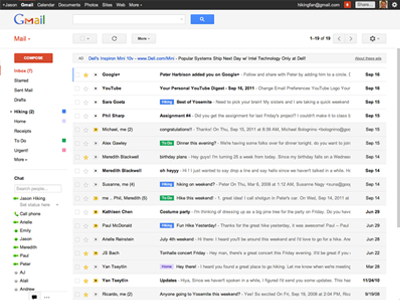
You might have noticed that Gmail looks a little different lately. We’ve made some changes at Google to make our products simpler and more consistent so that your experience can be more productive and enjoyable.

Why we made these changes

The way people use and experience the web is evolving, and our goal is to give you a more seamless and consistent online experience -- one that works no matter which Google product you’re using or what device you’re using it on. The new Google experience that we’re working toward is founded on three key design principles:
  • Focus: With the design changes in the coming weeks and months, we’re bringing forward the stuff that matters to you and getting all the other clutter out of your way.
  • Elasticity: The new design will soon allow you to seamlessly transition from your desktop computer to your mobile phone to your tablet, while keeping a consistent visual experience. We aim to bring you this flexibility without sacrificing style or usefulness.
  • Effortlessness: Our design philosophy is to combine power with simplicity. We want to keep our look simple and clean. But behind the seemingly simple design, the changes use new technologies to make sure you have all the power of the web behind you.

What's changed

Throughout Gmail, you’ll notice some changes in layout and color. We’ve also minimized or removed borders in certain areas to create a cleaner look. Below you’ll find a summary of specific improvements:
  • Options at the top
  • Using labels, chat, and gadgets
  • Reading your messages
  • Search and filters
  • Settings
  • Contacts
We think you’ll find the new design easier to use. If your account has been upgraded but you’re not quite ready to make the switch, you can temporarily switch back to old look by clicking the gear icon in the top corner and selecting the option to postpone switching. Gmail will offer the new look to you again after several days.

Options at the top

We’ve cleaned up the Gmail toolbar, and it stays with you so that you can reach these options at any time. All of your familiar features are still there. Here’s how they’ve changed:

  • Now you can access Contacts and Tasks by clicking Mail on the left, below the Gmail logo.
  • Toolbar options like Archive, Spam, and Labels are now collapsed until you need them. Select or open a message to see actions you can take.
  • Most toolbar options are now graphic icons or shorter text to keep your toolbar more consistent. They’re in the same order as before, and hovering over the buttons will remind you of their meaning. 
    Old: 
    New:
  • The +/- buttons have been removed. Instead, just click the importance tag on the left side of a message in the list, next to the sender’s name, to mark it as important or unimportant without opening it.
  • Oldest and Newest navigation options have moved beneath the message range. Hover over 1-50 to reveal them.
  • There’s a new gear icon to access your settings . Use it to change your theme, get help, and access all other Gmail settings.
  • The settings gear also has a new set of options called "Display Density". Experiment with these options to adjust how much information you see on the page. Learn more about how to use this setting.
Using labels, chat, and gadgets
The left side of Gmail that includes your labels, chat, and any additional gadgets you’ve used to customize Gmail is now more adjustable, more responsive, and faster. Here are some specific changes:
  • The column stays fixed in position as you scroll through your messages so that you don’t need to scroll up to get to your labels or chat list.
  • Click and drag the solid line below your list of labels to adjust the height of the panel below them.
  • If you have a large number of labels, moving the cursor over them will automatically expand the list, and moving the cursor away will automatically contract it. This way, you can keep them hidden until you need them.
  • By default, labels and chat always show. If you’ve added other features to the left side of Gmail, such as the Google Calendar gadget or the Quick Links lab, switch between chat and your gadgets with the icons at the bottom. 
  • Gmail will remember the toggle position the next time you sign in.
  • You can also click whichever icon is currently highlighted a second time to have neither chat nor gadgets show.
  • If you want to turn chat off, you can do so by clicking the gear icon, choosing Settings, clicking the Chat tab, and changing the setting to disable it.
  • You can use the arrow keys to navigate within the labels section, as well as between panels in Gmail.
  • The grey “Compose mail” button now stands out in red, unless you’ve switched to a different theme.

Reading your messages

We’ve streamlined email messages to make them easier to read and to better show who’s involved in a conversation.
  • When viewing the list of your messages, you can navigate via the arrow keys on your keyboard. A blue vertical line at the left shows which message is in focus, replacing the previous sideways arrows icon.
  • Messages in a thread flow together as a conversation. We’ve made them easier to read by removing extra surrounding graphics.
  • Put names to faces: images your contacts have selected to show (or images that you’ve selected to show for them) now appear next to each message.
  • If no image exists for a sender, a default icon shows that is colored to help indicate who said what.
  • The full list of message recipients is below the sender’s name. To show a long list, click the down arrow at the end of the row.
  • Click the down arrow  to reveal more details about each message, including cc assignment and exact date. This information was previously under the “show details” link.
  • Stars for individual messages in a thread are now on the right side, next to the reply button.
  • The “Reply” button on the right is now an icon
  • Beneath the arrow to the right of the Reply button, you’ll find the options to filter messages similar to the current one, reply to the sender by chat, and others.
  • Quoted text from earlier in the conversation is now collapsed within the "Show trimmed text" icon  rather than a text link. Click it to show or hide the trimmed content. Signatures are also collapsed under an ellipsis.
  • To mark messages you’re reading as important or not important, click the importance indicator next to the subject line. Or, click More in the application toolbar next to the "Move to" and "Labels" icons: 
  • Reply quickly using the box at the bottom of a conversation, or use the Reply, Reply to all, and Forward links within the box.
  • The Archive, Spam, Delete, etc., options are no longer at the bottom of the message. These options stay fixed at the top while you move down the page, so they’re always on the screen.

Search and filters

Search in Gmail is easy and powerful. Use the search box at the top to find things in Gmail and on the web.
  • There’s now a single magnifying glass button for Search. You can still use the same text box to “search Mail” and “search the Web.”
  • Access the “Advanced search options” and “create a filter” tools using the small arrow in the search box. Clicking this arrow will open the new advanced search tool.
  • If you want to create a filter to automatically take actions on your messages, after filling in the search terms, click “Create filter with this search” at the bottom of the advanced search tool. You’ll see your test search results behind a new set of options to help finish creating your filter.
  • After you perform a search by clicking the magnifying glass icon, you’ll see the text version of your search term in the search box.
  • You can still search across the web from the Gmail search box; when you type your query, an option to search the web will show up as a drop-down. 

Settings

Most of your settings are the same, and you can access them by clicking the gear icon. 
  • Themes have been refreshed with new background color and image options. A small number of themes are no longer supported in the Gmail upgrade. We’re working to improve older themes and create new ones.
  • It’s no longer possible to customize Web Clips with your chosen RSS feeds. If you previously customized them, visit the Web Clips tab of the Settings page to get a copy of your feeds list.
  • It’s no longer possible to limit your contacts’ pictures to only the ones you’ve chosen for them. You’ll always see your contacts’ chosen pictures next to messages from those contacts; if you have contacts without associated pictures, you can still add ones of your own.
  • If you need to use the basic HTML version of Gmail, access it here; if you always need to use the basic HTML version, change your setting when prompted.

Contacts

To access the contact manager in Gmail, first click Mail at the top left and choose Contacts.
  • As in Mail, your toolbar buttons remain collapsed until you select or open a contact.
  • The “Add to My Contacts” button is now an icon. 
  • The “Groups” button is now an icon. 
  • The “Email” button is now an icon. 
  • The left side of the page automatically expands on mouseover if you have a lot of contact groups, just like labels.
  • To get to the end of your contacts list quickly, click the range of names at the top right of the list.
  • You can still assign a picture to contacts who don’t have one of their own set, but you can no longer suggest that picture to the contact.
It’s no longer possible to access the older, deprecated contact manager.

Tag Cloud

More Details here
Blogger Widgets